
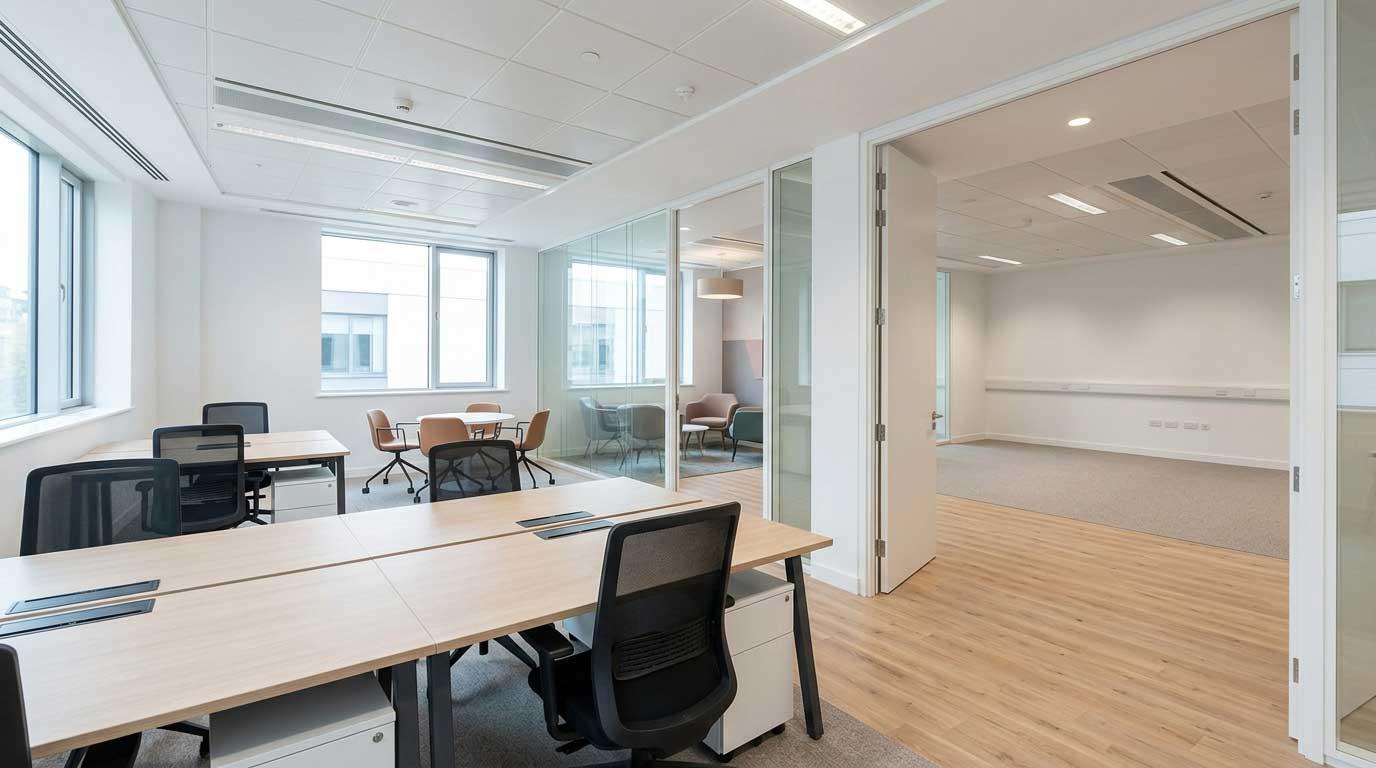
Offices in Dublin with Room to Expand

Choosing an office is not only about finding enough desks for your team today. For a growing business, the more important question is whether the office can continue to work as the company adds people, changes how teams collaborate and takes on new requirements.
Moving office too often creates unnecessary cost and disruption. A space that feels right for a team of 12 can become restrictive very quickly if the company grows to 18 or 20 people and there is no adjacent space, no ability to add desks and no flexibility in the agreement.
Dublin offers a wide range of serviced offices, managed offices and traditional leases. The right option depends on your growth plan, budget, preferred location, and the level of certainty you have about future headcount.
At Ping Offices, we help growing businesses compare office options across Dublin, including buildings that allow teams to expand without restarting the entire office search.
Why Room to Expand Matters
Growth rarely happens in a perfectly straight line. Some businesses add two or three people gradually, while others win a major contract, complete a funding round or build a new team in a matter of months.
An expansion-friendly office gives a business more options when those changes happen.
Businesses usually value:
The ability to add desks within the existing office
Access to adjacent suites or larger offices in the same building
Flexible agreement terms
Shared meeting rooms and breakout areas
Space for new teams or project groups
- The option to scale without a full relocation
The objective is not to pay for a large amount of empty space. It is to choose an office structure that gives the business realistic options as headcount changes.
What Does an Expansion-Friendly Office Look Like?
The best growth offices are not always the largest offices. In many cases, the most useful feature is the ability to change the amount of space you occupy over time.
When reviewing office options, look for:
Several office sizes within the same building or operator portfolio
Adjacent suites that can be combined
Shared meeting rooms that reduce the need to build every facility inside your own office
Breakout space and phone booths outside the private suite
Flexible licence or lease terms
Clear expansion rights or first refusal on nearby space where possible
- Layouts that can accept additional desks without affecting circulation or comfort
A building with several different office sizes can be particularly useful. A company may be able to begin in a smaller private office and later move to a larger suite in the same building, keeping the same address and minimising disruption for employees and clients.
Serviced Offices for Growing Teams
Serviced offices are often a strong choice for businesses that expect growth but cannot accurately predict the timing.
They typically provide fully fitted offices with shared amenities and flexible agreements. This can make expansion easier because the operator may have several office sizes within the same building or across nearby locations.
Common advantages include:
Fitted and furnished offices
Shorter and more flexible agreement terms
Meeting rooms and shared breakout areas
The ability to move into a larger office within the same building, subject to availability
No need to manage a separate office fit-out
- Simple monthly cost structures
The main consideration is availability. A provider may have suitable expansion space today but cannot always guarantee that a neighbouring office will remain available in the future. Growth expectations should therefore be discussed before signing an agreement.
Managed Offices for Businesses Planning Ahead
Managed offices can work well for larger or more established teams that want a private office designed around their requirements while retaining more flexibility than a conventional lease.
These spaces can often be configured around the business, including:
Dedicated meeting rooms
Private kitchens
Executive offices
Phone booths and quiet rooms
Project space
- Additional desk capacity for planned growth
For businesses with a reasonably clear 18- to 24-month headcount forecast, a managed office can provide a useful middle ground between the flexibility of serviced space and the control of a traditional lease.
Traditional Leases and Future Expansion
A traditional lease can also support growth, but the expansion strategy needs to be considered more carefully before the business commits.
The office may offer excellent value and long-term control, but a fixed floorplate can become restrictive if the business grows faster than expected.
Before taking a lease, consider:
Whether additional floors or suites may become available
Whether the landlord would consider expansion rights
Whether the lease contains a suitable break option
How easily the floor can be reconfigured
The cost of adding furniture, meeting rooms and infrastructure
- The likely cost and disruption of moving if the office is outgrown
For businesses with stable headcount and long-term certainty, a lease can be the right choice. For fast-growing companies with less predictable plans, flexibility may be more valuable than a lower headline rent.
Plan Around Your 18- to 24-Month Headcount
One of the simplest ways to improve an office search is to separate current headcount from likely future headcount.
For example, a business with 12 employees today may expect to reach 18 within a year. Taking an office with 30 desks immediately may be wasteful, but taking a rigid 12-desk office with no expansion options creates a different problem.
A better approach is to assess:
Current full-time headcount
Confirmed hires
Probable hires over the next 12 months
Possible growth over the following 12 months
Average office attendance on busy days
Meeting room and collaboration demand
- Visiting staff, clients and project teams
This creates a practical range rather than a single number. The right office can then be assessed against both the current requirement and the likely growth scenario.
Avoid Taking Too Much Space Too Early
Planning for growth does not mean taking the largest office you can afford.
Too much unused space can create unnecessary cost, reduce energy in the workplace and leave the business paying for desks it may not need for years.
A more efficient strategy may be to choose a building where the business can:
Start in the right-sized office
Use shared meeting and breakout facilities
Add desks within the existing suite where practical
Take the adjacent space later
- Move to a larger office in the same building or nearby portfolio
The goal is controlled flexibility: enough capacity to support growth without carrying excessive empty space from day one.
Dublin Locations with Good Options for Scaling Businesses
Different Dublin business districts offer different types of office stock. The right location will depend on your team, clients, transport needs and budget.
Popular areas for growing businesses include:
Dublin 2
Dublin 2 offers a wide choice of serviced, managed and leased offices around St Stephen's Green, Baggot Street, Fitzwilliam Square, Merrion Square and Harcourt Street. It is popular with professional services, finance, legal and technology businesses that want a central address and strong transport connections.
Docklands and Grand Canal Dock
The Docklands and Grand Canal Dock are popular with technology, finance and international businesses. The area contains a mix of modern office buildings and flexible workspace providers, which can give growing teams several routes to expansion.
Dublin 4 and Ballsbridge
Ballsbridge and the wider Dublin 4 area offer a mix of modern offices, established business addresses and strong transport connections. The area can suit companies looking for a professional setting with access to both city-centre and suburban transport routes.
South Inner City
Areas around Charlemont Street and the south inner city can offer a strong balance of central location, transport access and varied office stock. They are worth considering for businesses that want access to Dublin 2 without being limited to the most premium addresses.
How Hybrid Working Changes Expansion Planning
Headcount alone does not determine how much office space a business needs. Hybrid working means a company with 30 employees may not need 30 permanent desks, but it may need more meeting rooms, collaboration space and quiet areas than a traditional office layout provides.
Before choosing an office, consider:
How many people attend on the busiest day of the week
Whether teams need assigned desks or shared workpoints
How often client meetings take place
Whether employees need private rooms for video calls
How much breakout and collaboration space is required
- Whether visiting teams need temporary desks
A well-planned hybrid office can support significant headcount growth without requiring the business to increase desk numbers at the same rate.
Questions to Ask Before You Commit
When viewing an office with growth in mind, ask clear questions about what happens if the business expands.
Useful questions include:
Can we add desks to this office?
Are there larger suites in the building?
Can adjacent offices be combined?
What expansion options have other tenants used?
Can we transfer to another office within the operator's portfolio?
What notice period applies if we need to move to a larger suite?
Are meeting rooms included or charged separately?
Is there storage space for future equipment or furniture?
- Can the layout be changed during the agreement?
The answers should form part of the commercial comparison, not be treated as an afterthought once a preferred office has already been selected.
The Cost of Moving Too Often
Relocating an office involves more than the direct moving cost. There is also management time, IT coordination, address changes, employee communication and disruption to normal operations.
For that reason, the cheapest office today is not always the lowest-cost option over the next two or three years. An office with sensible expansion options can protect the business from an unnecessary move and give management more time to focus on growth.
How Ping Offices Can Help
Every growing business has a different expansion pattern. Some companies want to add a small number of desks gradually, while others need the ability to double in size within 12 to 24 months.
At Ping Offices, we compare office space across Dublin based on your current requirement, expected headcount growth, preferred location, budget and working model.
As an independent office advisory business, we search the entire market rather than representing a single provider. We can identify buildings with multiple office sizes, compare serviced, managed and leased options, arrange viewings, negotiate commercial terms and help you understand the practical expansion risks before you commit.
Our service is completely free for occupiers, with our fees paid by landlords and office providers.
Frequently Asked Questions
How much extra office space should a growing business take?
There is no single answer. The right amount depends on confirmed hiring plans, likely growth, office attendance and the flexibility available within the building. In many cases, access to expansion space is more valuable than paying for a large amount of unused space from day one.
Are serviced offices suitable for growing businesses?
Yes. Serviced offices can be a strong option for scaling teams because they provide fitted space, flexible terms and, in many buildings, the possibility of moving to a larger office as the business grows. Expansion remains subject to availability, so future plans should be discussed before signing.
Can we expand within the same building?
Often, yes. Many serviced and managed office buildings contain several suite sizes, and some traditional office buildings have additional floors or adjacent units. The important point is to confirm what is realistically available and whether any expansion rights can be agreed.
Should we choose a larger office now to avoid moving later?
Not automatically. Paying for a large amount of unused space can be expensive. A better option may be a right-sized office in a building that offers a clear route to expand through adjacent suites, larger offices or flexible agreement terms.
Can Ping Offices help us find offices with room to expand?
Yes. Ping Offices compares suitable offices across Dublin based on current headcount, expected growth, budget, location and workplace requirements. We can shortlist options that provide realistic expansion routes and help negotiate the right commercial terms.
Final Thoughts
For a growing business, the best office is not simply the one that fits today. It is the one that gives the company enough flexibility to handle tomorrow without creating unnecessary costs in the meantime.
That may mean a serviced office with several suite sizes, a managed office designed with additional capacity, or a traditional lease with sensible expansion and break options. The right answer depends on how predictable your growth is and how much flexibility the business needs.
At Ping Offices, we help businesses compare offices across Dublin with both current requirements and future growth in mind. From small teams taking their first private office to established companies planning their next stage of expansion, we help you find the right space and negotiate the right structure for the business.
News insight
 Jul 02, 2026
Business Setup Ireland Checklist: Your Step-by-Step Guide to Expanding into Ireland
Starting a business in Ireland checklist
 Jul 02, 2026
Central Business Districts in Ireland: Choosing the Right Location for Your Business
Central Business Districts in Ireland
 Jul 02, 2026
IDA Ireland Support: How International Businesses Can Benefit
IDA Support Ireland
Thanks! We've got your request.
Our team will review your details and be in touch shortly with your personalised quote.